
Namesake
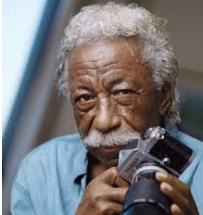
Gordon Parks
AKA: Gordon Roger Alexander Buchanan ParksBorn: November 30, 1912
Birthplace: Ft. Scott, Kansas
Died: March 7, 2006
He was stillborn—no heartbeat, declared dead by the family doctor and put aside for later burial. Another doctor in the delivery room had an idea and immersed the newborn in ice-cold water. The shock caused his heart to start beating, and the baby was soon crying and healthy. He was named after Dr. Gordon, who had saved his life. In over ninety years, Gordon Parks became internationally renowned as a Photographer, filmmaker, poet, novelist, and composer.
Parks grew up poor in Fr. Scott, Kansas, the youngest of 15 children. His mother died when Parks was 14, and he was sent to live with an older sister in Minneapolis until her husband kicked him out. Between bouts of homelessness, he earned rent as a piano player. He also worked as a busboy,
porter, and later a waiter on the transcontinental North Coast Limited Railroad.
At 25, he bought a used camera for $7.50 and began working as a self-taught freelance photographer, focusing on everything from fashion to poverty. By 1944, he was the only black photographer working for Vogue Magazine, and in 1948 he became the first black photographer at Life Magazine, the most prestigious magazine of its day for photography. Eventually, Life sent him to France, Italy, and Spain, and he became known for his photos documenting the civil rights movement.
His autobiographical novel The Learning Tree, covering his rough Kansas childhood, won rave reviews and strong sales. When Warner Brothers expressed interest, Parks told them he would direct the film himself, and he became the first African-American to direct a film for a major studio.
He went on to direct Shaft and several other movies. Parks co-founded Essence Magazine and wrote a ballet called Martin in honor of Dr. Martin Luther King, Jr. His numerous books include The Sun Stalker, Poet & His Camera, To Smile in Autumn, and his autobiography, Voices in the
Excerpt from: http://www.nndb.com/people
porter, and later a waiter on the transcontinental North Coast Limited Railroad.
At 25, he bought a used camera for $7.50 and began working as a self-taught freelance photographer, focusing on everything from fashion to poverty. By 1944, he was the only black photographer working for Vogue Magazine, and in 1948 he became the first black photographer at Life Magazine, the most prestigious magazine of its day for photography. Eventually, Life sent him to France, Italy, and Spain, and he became known for his photos documenting the civil rights movement.
His autobiographical novel The Learning Tree, covering his rough Kansas childhood, won rave reviews and strong sales. When Warner Brothers expressed interest, Parks told them he would direct the film himself, and he became the first African-American to direct a film for a major studio.
He went on to direct Shaft and several other movies. Parks co-founded Essence Magazine and wrote a ballet called Martin in honor of Dr. Martin Luther King, Jr. His numerous books include The Sun Stalker, Poet & His Camera, To Smile in Autumn, and his autobiography, Voices in the
Mirror. Gordon Parks’ life is a testament to hard work and perseverance. He never gave up despite the many obstacles placed before him. We are honored to have his name attached to our school.